What Is an SMS API and How Does It Work for Indian Businesses
A customer waiting on a delivery update, a bank confirming a payment with a one-time password, a clinic reminding a patient about tomorrow's appointment — all of it depends on one message reaching a phone within seconds, not eventually. Try to do that by typing out texts one at a time and the reliability disappears the moment volume grows. An SMS API is what lets an application send that message automatically, the instant an event happens, without anyone touching a phone.
What separates a working setup from a frustrating one usually isn't the code — most providers expose a similar set of send-and-track endpoints. It's whether messages actually clear India's DLT framework instead of getting silently dropped, whether delivery data shows up in real time, and whether integration takes an afternoon instead of a support-ticket-filled week.
As a DLT-registered messaging platform running SMS, RCS, Voice and WhatsApp from a single dashboard, A2ZSMS treats SMS API as one reliable channel in a wider communication stack — not a bare endpoint you're left to configure alone. This guide walks through what an SMS API actually is, how it works end to end for an Indian business, DLT compliance, pricing and what to check before choosing a provider.
What Is an SMS API?
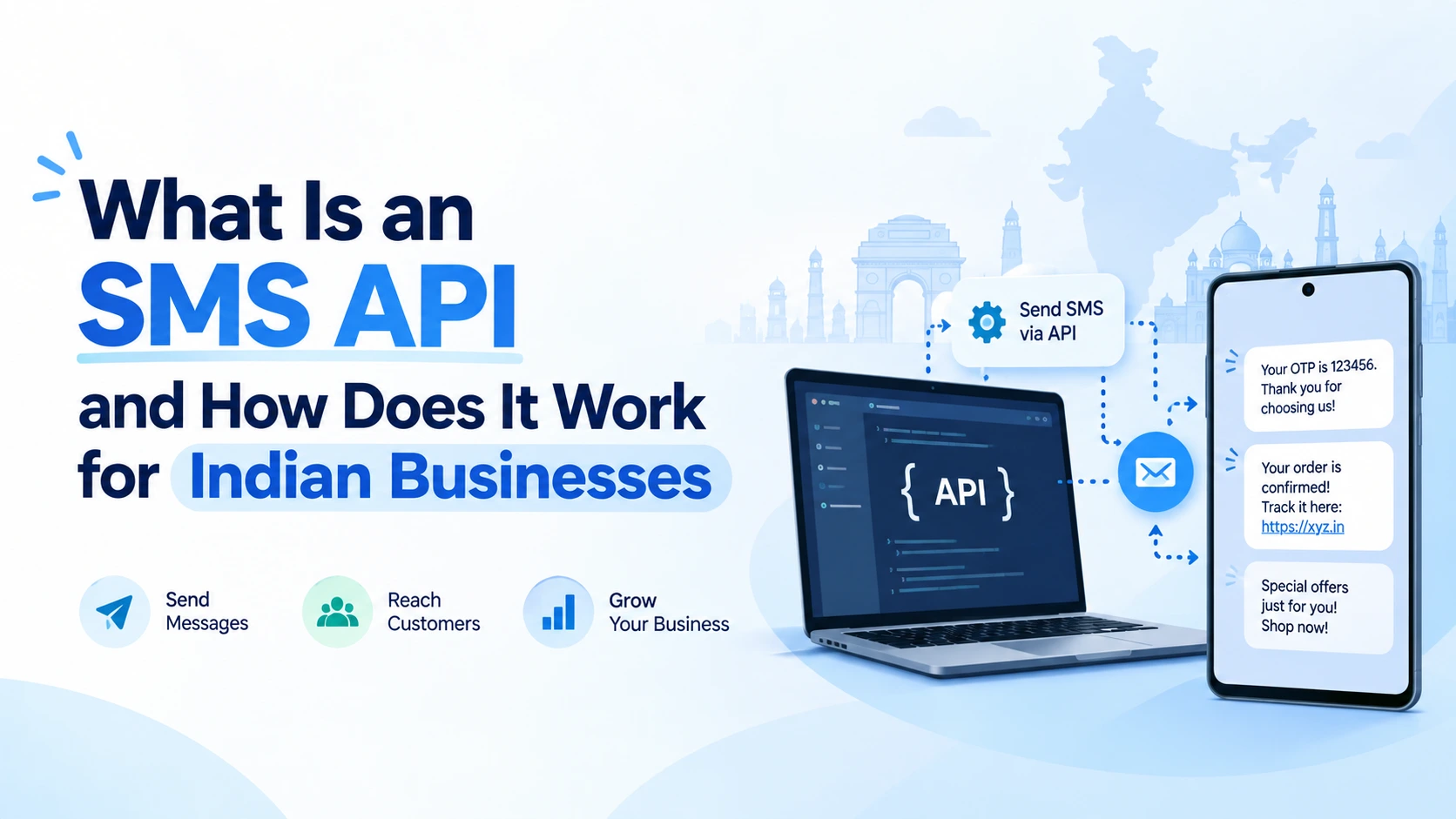
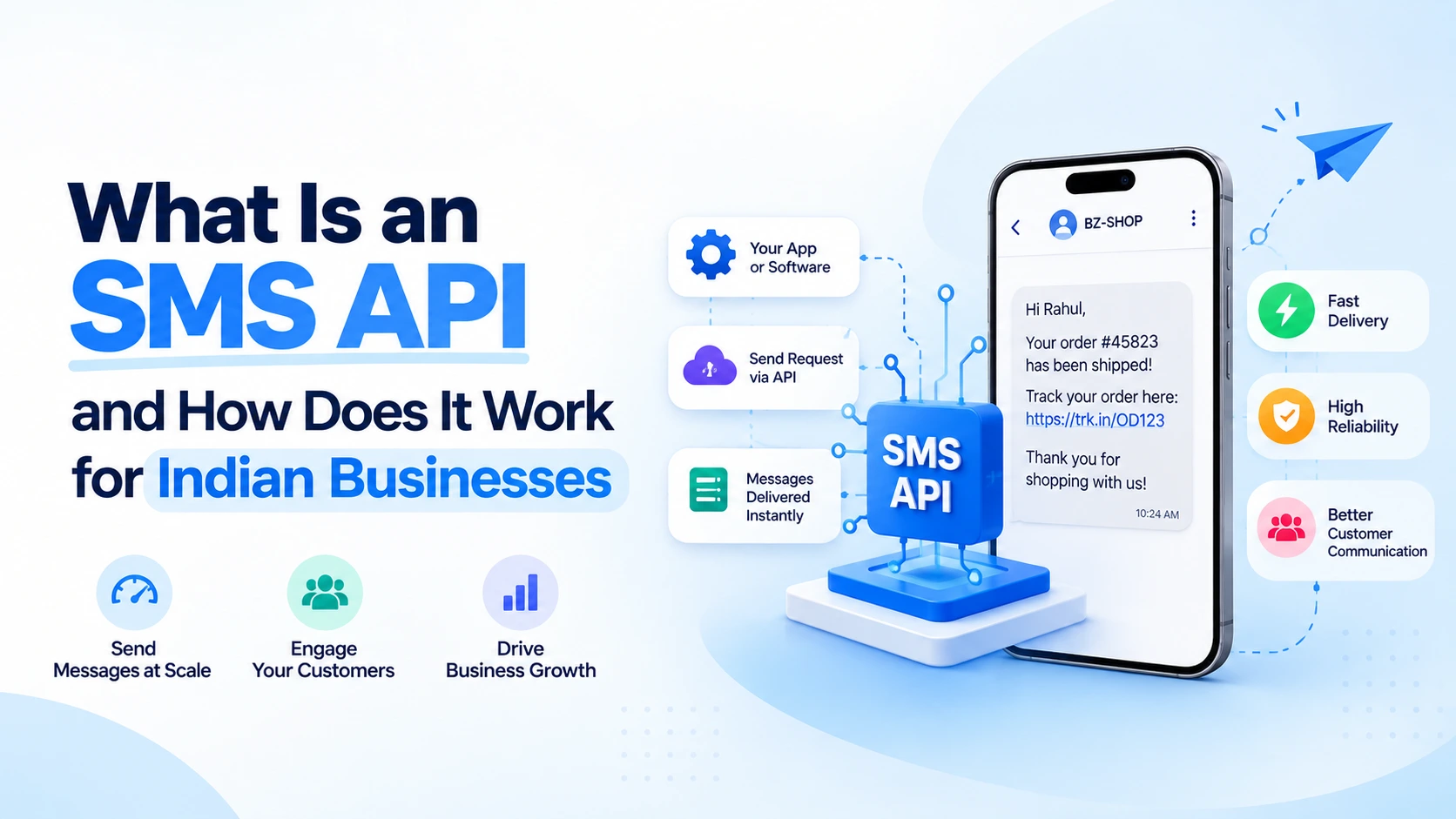
An SMS API (Application Programming Interface) is the piece of software that lets your app, website or CRM send and receive text messages without a person manually dialling a number. Your system passes along the recipient's number and the message content; the API handles authentication, routes the request to a telecom network, and reports back whether it was delivered. Everything from an OTP triggered at login to a shipment update triggered by a warehouse scan runs through this same mechanism.
Transactional Messages: OTPs, payment confirmations and delivery alerts triggered by a customer action.
Promotional Messages: offers and announcements sent to an opted-in customer list.
Two-Way Messaging: customer replies routed back into your application or CRM.
Delivery Reporting: real-time status on whether each message actually reached the handset.
How an SMS API Delivers a Message End to End
The mechanics behind a single SMS are more involved in India than most global explainers let on, mainly because of one step almost nobody can afford to skip.
Your Application Sends the Request: triggered automatically by an event — a login, an order, an appointment.
The API Authenticates and Matches a DLT Template: your API key is verified, and the message content is checked against your registered template before it can proceed.
The Telecom Network Delivers It: the request routes through the operator network to the recipient's handset.
Your System Gets a Delivery Report: confirmation comes back as delivered, pending or failed, without anyone checking manually.
Why DLT Registration Is Non-Negotiable for SMS API Use in India
DLT (Distributed Ledger Technology) is the blockchain-based registration system that TRAI (Telecom Regulatory Authority of India) requires every business to complete before sending commercial SMS to Indian numbers. It exists to confirm that whoever is sending a message is a verified, traceable entity — not an anonymous bulk sender.
Entity Registration: your business is registered as a Principal Entity on a DLT platform before anything else can happen.
Sender ID (Header) Approval: the short code or name customers see as the message sender.
Template Approval: every message format needs pre-approval before it's allowed to send.
Without It, Nothing Sends: messages are blocked by the operator before they reach a phone, no matter how well the API integration itself is built.
Compliance and Security Basics for SMS API Senders
DLT covers who's allowed to send. A few other basics govern how responsibly that sending happens once you're approved.
Opt-In and DND Compliance: promotional messages should only reach numbers that have consented, and TRAI's do-not-disturb registry still applies.
Encrypted Transmission: requests should move over secured connections between your application, the API and the telecom network.
Data Handling Aligned With DPDP: customer numbers and message content should be handled in line with India's Digital Personal Data Protection Act.
Sender ID Must Match Your Business: a registered header should be recognisably yours, not a generic or shared code.
Where Indian Businesses Put SMS API to Work
The underlying API is the same everywhere — what changes is which trigger fires it.
| Industry | Typical SMS API Use | Main Benefit |
|---|
| Banking & Finance | OTPs, transaction alerts, payment reminders | Instant, traceable verification |
| E-commerce & D2C | Order confirmations, shipping updates, COD reminders | Fewer "where is my order" support calls |
| Healthcare | Appointment reminders, report-ready alerts | Lower missed-appointment rates |
| Logistics | Delivery ETAs, OTP-based handover confirmation | Fewer failed or disputed deliveries |
| Education | Attendance alerts, fee-due reminders | Direct reach to parents without needing an app |
What SMS API Pricing Actually Includes in India
SMS API pricing isn't one number — it's a per-message rate plus a few charges that are easy to miss until the first invoice arrives.
| Pricing Component | What It Covers | Typical Billing Basis |
|---|
| Per-SMS Rate | Cost per message segment sent | Charged per message or credit |
| DLT Registration Fees | Entity, sender ID and template approval | One-time, separate from API usage |
| API Platform Access | Dashboard, delivery reports, integration support | Monthly or pay-as-you-go |
| GST | Tax on subscription and usage charges | 18%, added to every invoice |
Ask for a Real INR Quote: request pricing based on your expected monthly SMS volume, not a generic listed rate.
Checklist for Choosing an SMS API Provider in India
Rather than comparing homepages, run every shortlisted provider through the same short list of questions:
DLT Support Included: confirm the provider helps with entity, sender ID and template registration, not just the API itself.
Delivery Reporting Detail: ask how granular the delivery and read data is, down to the message level.
Documentation Quality: clear, testable API docs save weeks during integration.
Support During Live Issues: check response times when a transactional flow breaks, not just at onboarding.
Transparent Per-Message Pricing: a real rate card, not a "contact sales" page.
Room to Add Channels Later: WhatsApp, RCS or Voice on the same account if you scale beyond SMS.
Steps to Get Your SMS API Integration Live
Most businesses go from signup to their first live message in a handful of steps, once DLT registration is out of the way.
Complete DLT Registration: register your entity, sender ID and message templates before any integration work starts.
Get Your API Credentials: receive an API key and endpoint documentation from your provider.
Integrate the API Into Your Application: connect it to the event that should trigger a message — signup, order, appointment.
Test With Approved Templates: send test messages against your registered templates before going live.
Go Live and Monitor Delivery: track delivery reports and adjust templates or routing as needed.
Why Businesses Choose A2ZSMS for SMS API
Plenty of vendors can hand you an API key. Here's what sets A2ZSMS apart as a partner built to run SMS as part of a full messaging stack, not a standalone endpoint.
One Dashboard for Every Channel: SMS, WhatsApp, RCS and Voice managed from a single screen, with fallback between them.
DLT Registration Handled for You: entity, sender ID and template approvals managed as part of onboarding, not left for you to figure out alone.
Transparent Per-Message Pricing: a real INR rate card once your volumes are known.
Real-Time Delivery Reporting: see sent, delivered and failed status at the message level.
Support in Your Own Time Zone: a team that responds when your systems are actually live.
Talk to a Reliable SMS API Provider in India
Move OTPs, alerts and updates off manual processes and into one DLT-compliant, trackable channel. Whether you're integrating your first SMS flow or replacing an unreliable provider, A2ZSMS gives you DLT support, real-time delivery reporting and transparent INR pricing — so every message actually reaches its recipient.
Start a Free Trial: experience the A2ZSMS platform across SMS, WhatsApp and RCS, with guided onboarding.
Request a Live Demo: see the API, delivery reporting and DLT workflow running live, with pricing mapped to your volumes.
Talk to Our Team: call +91 84310 86185 or email sales@a2zsms.in to discuss your requirements.
Conclusion
An SMS API works best for an Indian business when it's treated as a compliant, monitored channel — DLT-registered, transparently priced, and backed by real delivery data — rather than a bare endpoint bolted onto an application. What actually separates one provider from another shows up in the details: whether DLT is handled for you, whether pricing is a real number instead of a "contact us" page, and whether delivery reporting is genuinely real time.
For a business comparing options, the question is less about the technology and more about the partner. A dependable SMS API for Indian businesses should come with DLT support, clear pricing and real delivery visibility bundled in, not sold separately.
A2ZSMS brings SMS, WhatsApp, RCS and Voice together on a single, DLT-compliant platform with transparent INR pricing and hands-on support. Ready to see it for your own use case? Start a free trial or request a live demo.
Frequently Asked Questions: SMS API for Indian Businesses
An SMS API is the piece of software that lets an application send and receive text messages automatically, without a person sending each one manually. Your system passes along the number and message; the API handles authentication, delivery through the telecom network, and reports back the result.
Yes. TRAI mandates DLT registration for any entity sending commercial SMS to Indian numbers. Without a registered entity, sender ID and approved template, the operator blocks the message before it reaches the recipient — regardless of how well the API integration works.
Bulk SMS software is typically a dashboard you log into to send messages manually or upload a list. An SMS API is built for your application to trigger messages automatically based on events — an order, a login, an appointment — without anyone opening a dashboard at all.
Yes, when it's implemented correctly. Requests should move over encrypted connections, and access should be controlled with a unique API key per account so every request can be traced back to its source — which is exactly why banks and payment platforms rely on SMS APIs for OTP delivery.
Pricing usually combines a per-message rate with a one-time DLT registration cost and 18% GST on top. A2ZSMS shares a real per-message quote based on your expected monthly volume rather than a generic listed rate — request a demo and we'll walk through it.
Small businesses and startups are often the ones who benefit most — a single OTP flow or order-confirmation trigger can be integrated in a short development cycle, without the overhead a large enterprise rollout would need.
For a single use case like OTP verification or order confirmations, integration is typically a short, well-documented development task once DLT registration is complete. DLT approval timelines depend on the operator and how quickly your documents are submitted, so that's usually the longer part of the process, not the API work itself.
Yes, but they're treated differently under DLT — transactional messages like OTPs and promotional messages like offers need separate registered templates, and promotional messages must only go to numbers that have opted in.